
Thresholds: An Eerie Exploration into Liminal Art
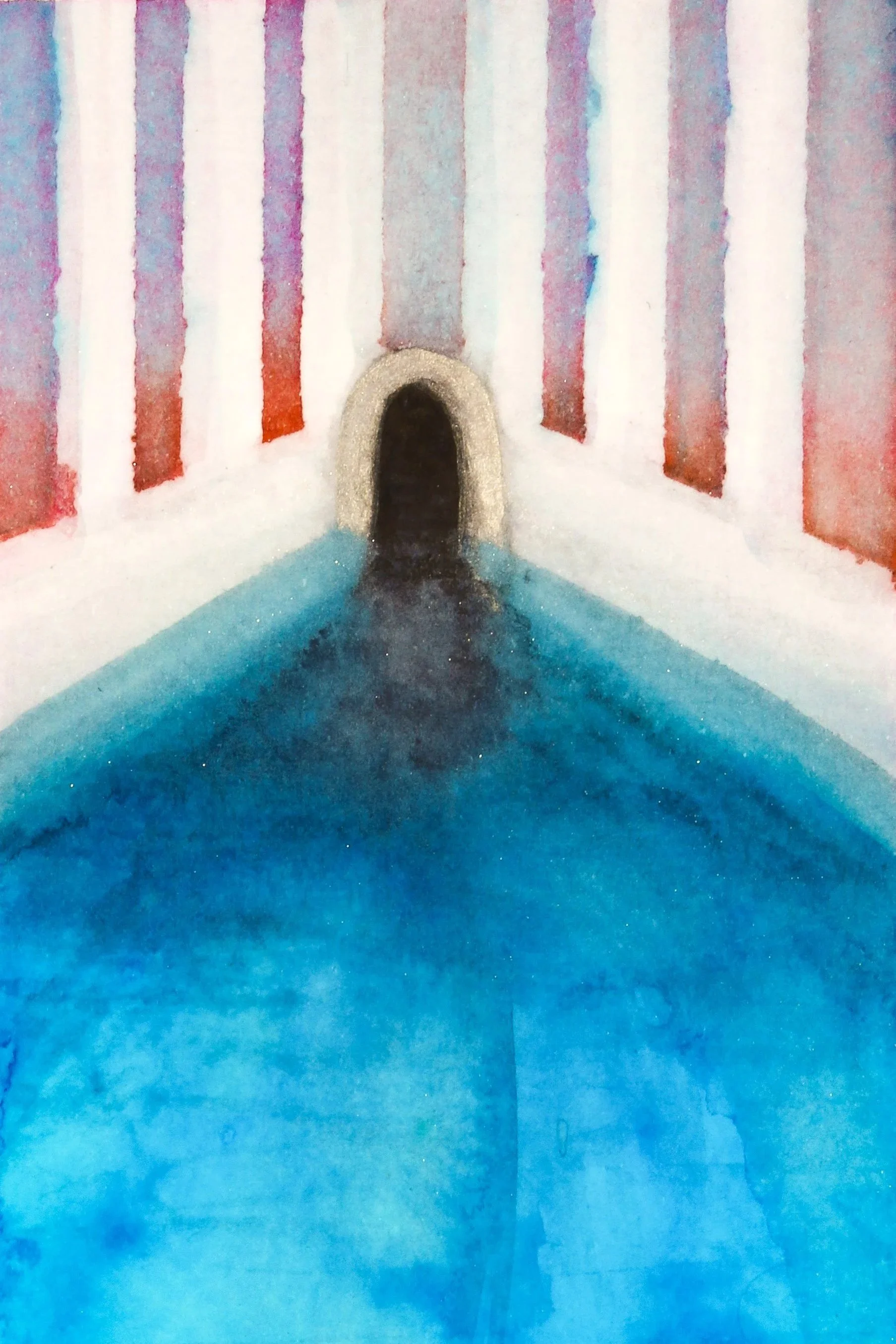
Anna Volk, Threshold, from the Postcards from Obscurity series, 2024, watercolor on paper, collection of the artist.
The flagship piece from a series I did awhile back that basically explores the liminal spaces in your own mind.
The other day, while deep in the bowels of my unfinished basement, I took a walk on the treadmill. It was partly for exercise and partly to brainstorm painting and tutorial content for the Halloween season that is now well underway. I mentally flipped through the classic motifs like pumpkins, goblins, and ghosts, but none of it served up a particularly strong flow of creative juice. So, naturally, I zoned out.
Now, that's a very easy thing to do considering the placement of my treadmill, which sits along the far brick wall of the basement and faces, well, another brick wall. After psychologically hitting said brick wall for about ten minutes, the wall...hit me right back. Liminal space.
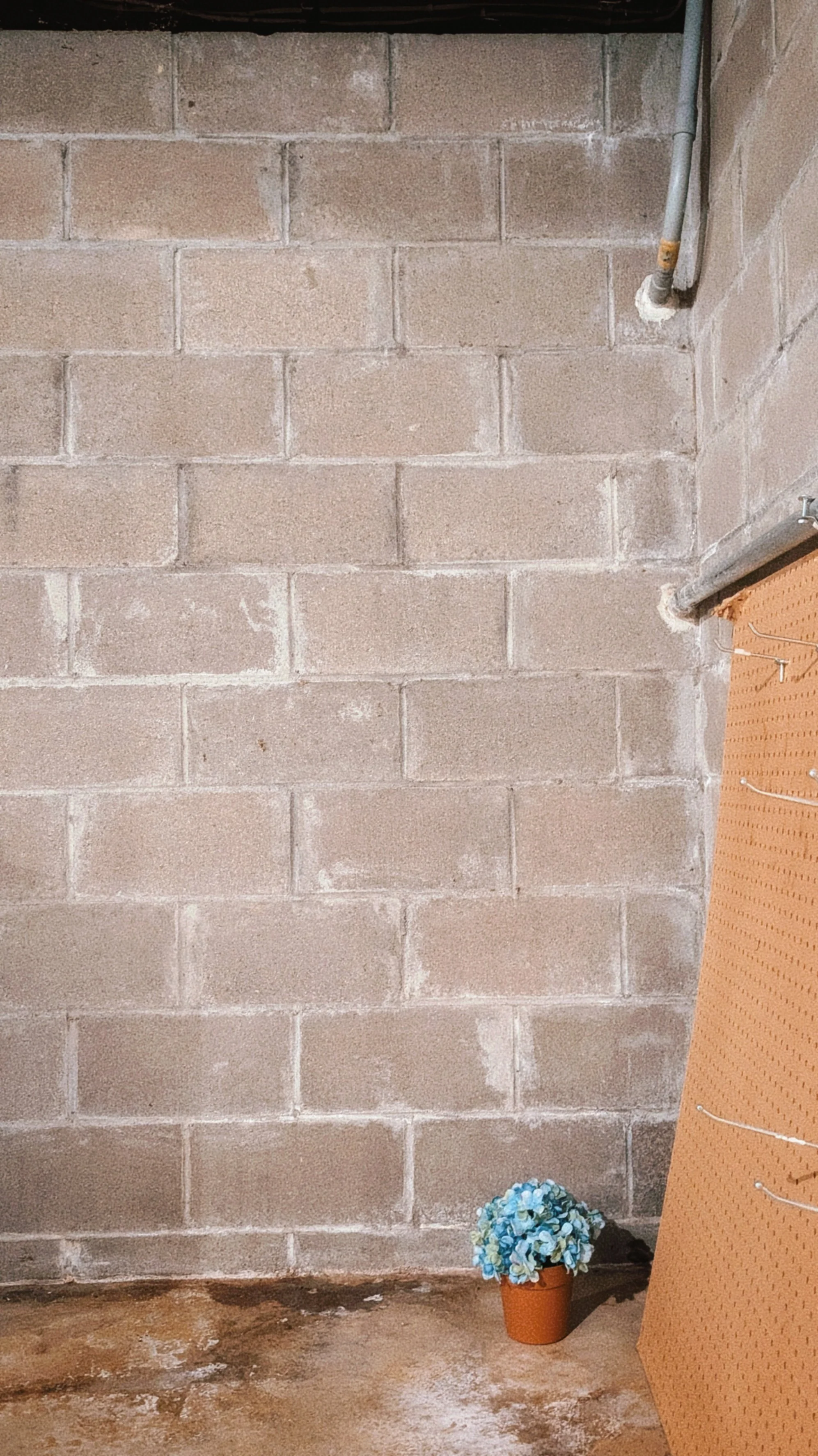
The liminal space that has apparently been staring me down for years…
I jogged my memory (the only thing jogging that day) and realized that I've had a fascination with liminal space for longer than I can remember and have been quietly cataloging its eerie manifestations for years. If you aren't familiar with liminal space, it's basically transient space built for passage rather than permanence and hosts a wealth of possibility when it comes to the unsettling and uncanny. It can take many forms, and it has done so in the visual arts for ages. Today we're unpacking the key concepts of liminal space to explore its halls and unlock its unlimited potential for truly haunting artwork.
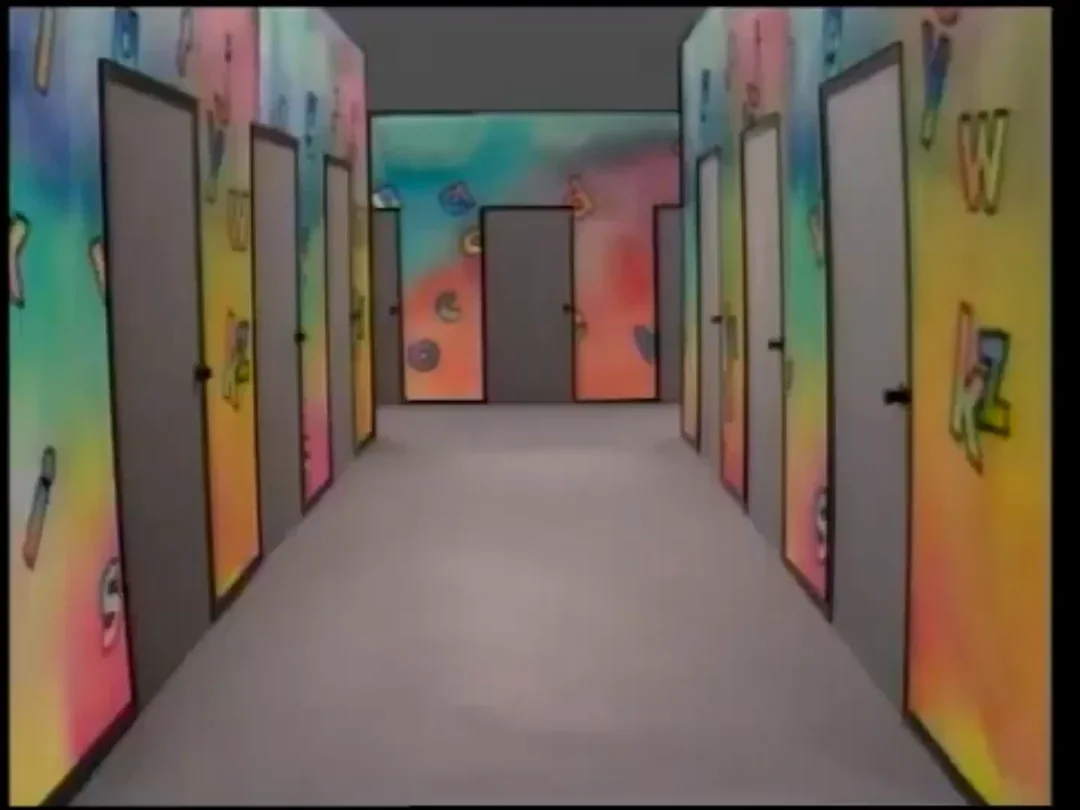
Still from Sesame Street, “Alphaquest” segment (Letter B), 1990. Children's Television Workshop. (As discussed in online liminal space communities).
This is where my fascination with liminal spaces began, and I’m sure this is the case for many other millennials.
The Keys to Unlocking Liminal Space
Technical Framework
To begin the discussion on liminal space, let’s start with the most obvious: a sense of suspension. When I say suspension, I don’t necessarily mean physically hovering above the ground, but hovering between two states. The word liminal comes from the Latin word limen, meaning threshold. Because liminal space is the in-between, it has no beginning, no end, and while you’re there, you’re actually nowhere.
Visually, liminal spaces are often framed by thresholds like doorways, archways, hallways, windows, or staircases. These frames evoke a sense of suspense about where the space may lead, and therefore an uncertainty about the reality of the liminal space itself.
The more frames nested within a frame the more acute the overwhelm becomes, because your mind can't neatly contain it or account for what might be awaiting beyond any given passage. This restrictive framing compels a choice: either cross a threshold into the unknown or forever be nowhere.
A great visual example of this is Roman Polanski’s Rosemary’s Baby. Notice in the photo below how Mia Farrow’s character, Rosemary, is flanked by dark thresholds as she flees down the halls of The Bramford apartment building. She is suspended in liminal space as she searches for safety. The repeated frames within frames feel endless and claustrophobic. The longer she remains there, the more the tension builds.
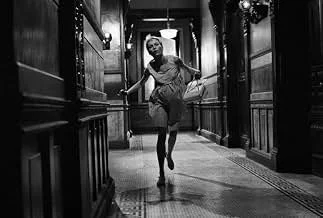
Roman Polanski, dir., still from Rosemary's Baby, 1968. Paramount Pictures. Source: IMDb
The frame-within-a-frame concept is used consistently throughout Rosemary’s Baby. All the apartments in the building, including her own, seem to be composed almost entirely of thresholds. The apartment itself becomes a liminal space that the characters endlessly pace. Looking at the collection of frames on all sides, as seen in the next photo, creates a sense of the unknown and an unease about what’s just out of frame.
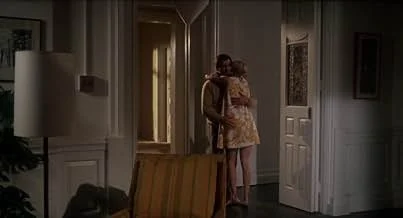
Roman Polanski, dir., still from Rosemary's Baby, 1968. Paramount Pictures. Source: IMDb.
Active Omission
Now that we’ve entered the framework of liminal space, naturally we want to look around. But, I’d be willing to bet that when you first scan the space you’ll notice what’s not there before you notice what is there. And what’s not there? Context and presence.
It’s instinctual to search for a visual anchor when surveying a scene for the first time. Visual anchors ground us and provide us with a sense of place or context, especially when the existing framework is rife with uncertainties. Anchors are things like clocks, signage, or even architectural markers that subtly provide order and direction as to how to move through a space, and they are presented in an expected way. Liminal space has no such contextual markers.
In lieu of contextual markers, a lost human brain typically resorts to searching for another human presence. Liminal space is fresh out of that, too. There’s no one to connect to, to explain, or to interpret the environment. This forces you into the role and perspective of the lone observer, tasked with understanding where you are and how to find the exit.
A great example of active omission is The Pool Rooms rendered by artist Jared Pike. As you can see in the still below, the space is completely devoid of explanation. There’s no signage or sense of time apart from what appears to be daylight breaking through an out-of-frame window. The architecture of the space only invites you further in without offering the reassurance that it will take you anywhere. And even though this is literally a pool room, the water isn’t deep enough for swimming, so it has no utility. Even if it were a public wading pool or bathhouse, there would be people there. However, as your lone observer eyes can see, it is completely vacant.
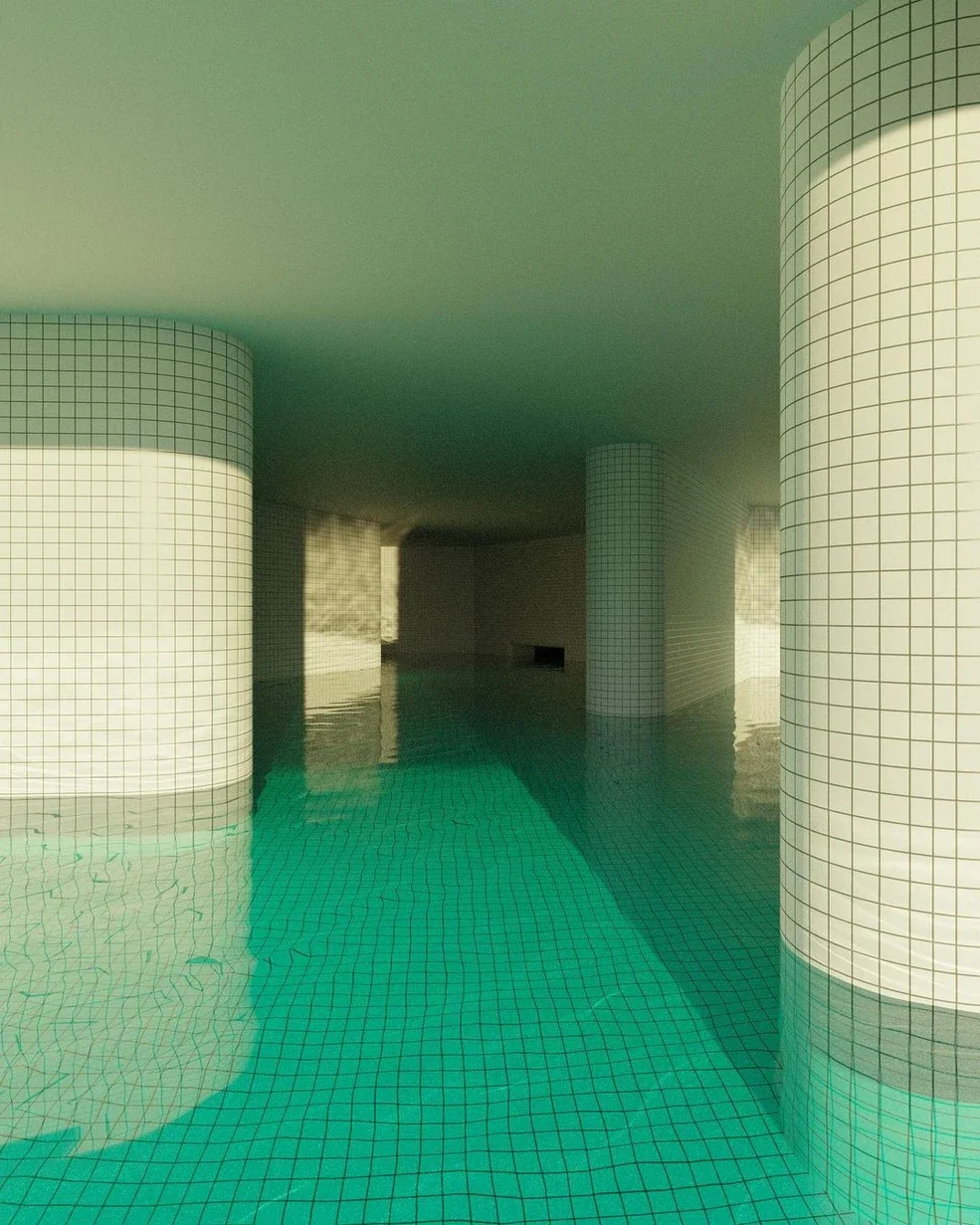
Jared Pike, Dream Pools, 2020. 3D digital rendering. Source: Wikipedia. Public Domain.
Omniscient Atmosphere
Once you’ve stumbled over what’s not in the liminal space, it finally starts to dawn on you what remains: the atmosphere of a dreamlike world. This is when that eerie feeling begins to crawl across your skin. It’s just you…and the space.
Edward Hopper’s famous painting, Nighthawks, flawlessly embodies this idea of omniscient atmosphere. Though the scene is set at night in what appears to be a diner in the heart of a city, the streets are completely devoid of all life. The windows and doors of the buildings surrounding the diner are not only dark, they’re empty and give no indication as to what they house.
Moving in on the actual diner, you soon realize that there appears to be no external door to get in or out. The people in the diner aren’t so much figures with presence as they are fixtures. You aren’t meant to connect with them; you are meant to observe as they drink their coffee in a fish bowl and silently keep the heavy atmosphere from completely collapsing into itself.
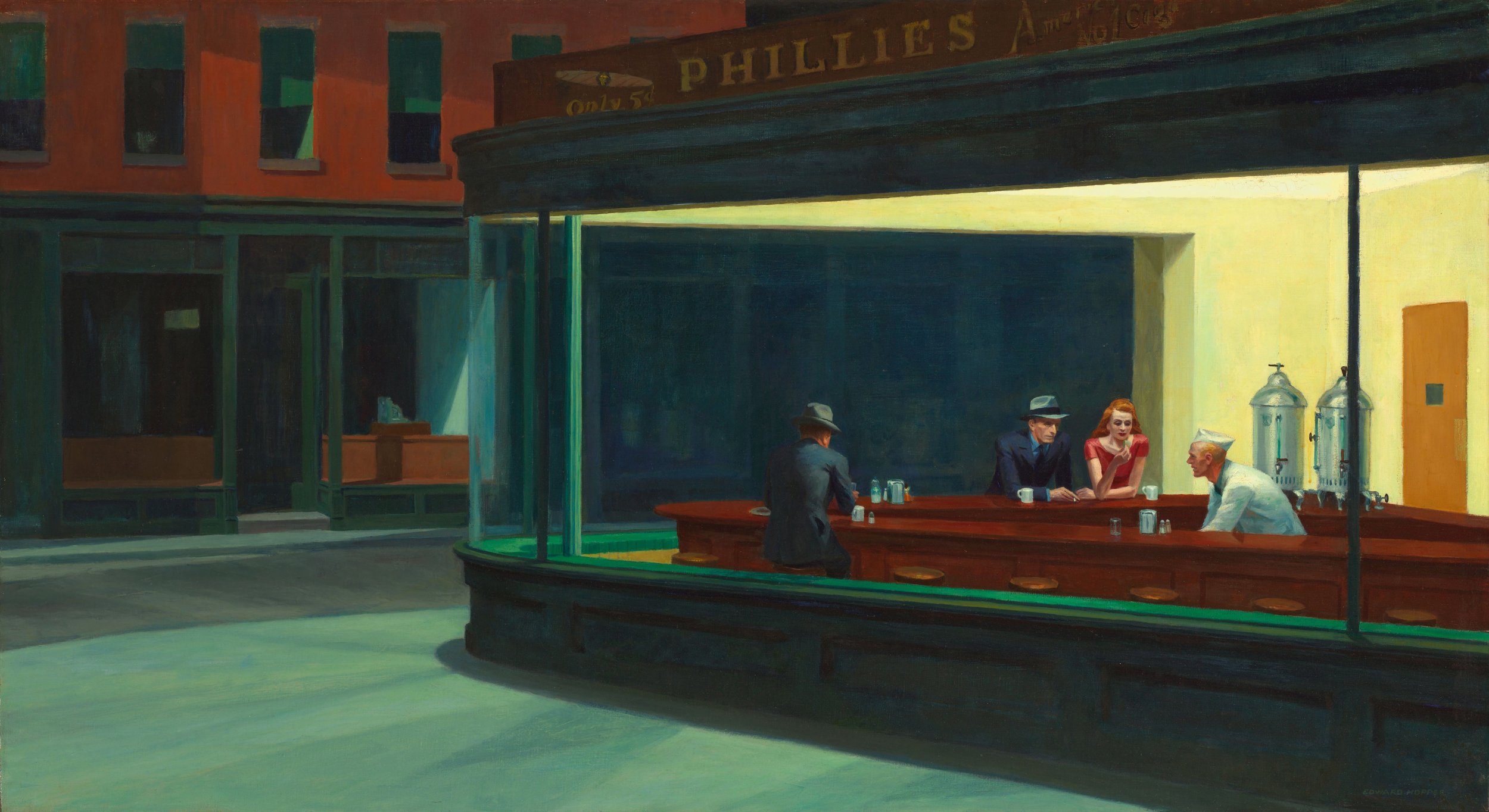
Edward Hopper, Nighthawks, 1942. Oil on canvas. Art Institute of Chicago. Source: Wikipedia. Public Domain.
Cumulative Effects
To simply isolate one key element of liminal space collapses its power. Creating a sense of liminality requires each element to build upon the other. It’s a chain reaction that goes something like this. The framework sets the stage by compelling a choice: stay in agonizing uncertainty or find an exit. So, you look for passage to the next place. Since contextual markers and guides have actively been omitted, you feel lost. To top it off, the isolation makes the atmosphere feel more suffocating every second you remain there. The cumulative effect is that you have nowhere specific to go but you can’t stay here, so you move—typically in circles. Is it any wonder that liminal spaces are so often used in horror films? They aren’t inherently horrifying, but they do create the perfect pressure cooker for a specific type of panic that sets people into motion.
The character Danny in Stanley Kubrick’s The Shining is a masterful depiction of how weaponized panic compels movement. His tricycle rides through the various floors of the Overlook Hotel begin as simple explorations, and at first you get clues as to where he is in time and space. But as he continues to ride, those external clues (like outside lighting and other people) fall away. All the hallways start to look the same, and the ride slowly starts to feel more circular and disorienting.
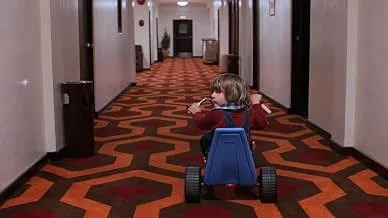
Stanley Kubrick, dir., still from The Shining, 1980. Warner Bros. Source: IMDb.
This circling gives way to a vague sense of déjà vu. The repetition of the frames and the unguided meandering blend into one memory. Some people describe this aspect of liminal space as anemoia, a longing and nostalgia for a time or place you’ve never experienced. Personally, I think anemoia is too friendly a term, because it implies something welcomed into memory. Déjà vu, on the other hand, is the uncanny feeling that something you’re looking at for the first time feels oddly familiar, but you don’t know why. It’s an interloping memory of sorts, which echoes the uneasiness at the core of liminality.
The prime example of this déjà vu effect is seen in “The Backrooms.” What started as a 4chan image thread has since evolved into a staggering amount of internet-based liminal lore as well as a Backrooms movie directed by Kane Parsons, released May 2026. Most people who look at the image below get an overwhelming sense of having been there before. I mean, haven’t we all?
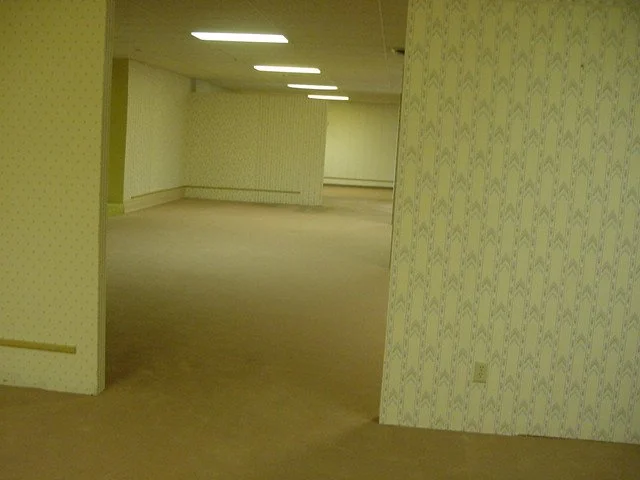
HobbyTown USA Oshkosh interior under construction (The Backrooms origin photo), 2002. Digital photograph. Source: Wikipedia. Public Domain.
Finding the Exit
At its core, what makes liminal space haunting at best, horrifying at worst, and many shades of sickly yellow in between, is the indelible dread of never arriving. To be stuck on a dream's treadmill and breathing ever-compacting air with no end in sight was never meant to be an inhabitable state. You don't find your way out of a liminal space by tearing around its corners, swimming through its atmosphere, or collecting its symbolic breadcrumbs. Escape doesn’t come because you suddenly find the answer that wakes you up to reality. It finds you when you can no longer bear to stay asleep in the dream.
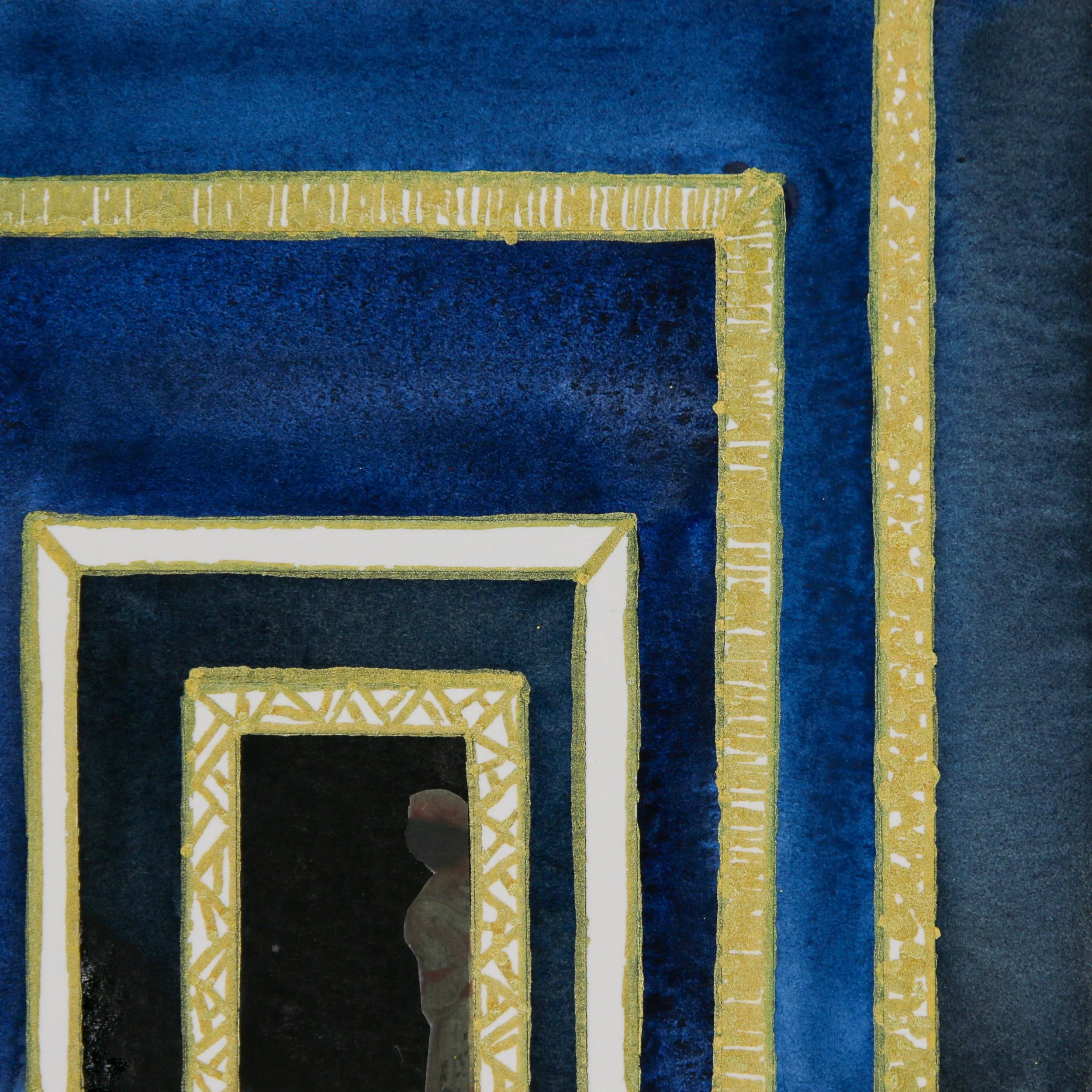
Anna Volk, Mirror, Mirror, 2026, mixed media on paper.
This piece features frames within frames, zero context, brooding atmosphere, and a fixed figure whose only function is to make you question yours. It is one of infinite visual interpretations of liminal space.
Though you may leave, liminal space remains indefinitely—always with the door slightly ajar. If you know that eerie feeling, share your liminal lore in the comments below. Thanks for reading!